What is microscopic discectomy?
The spine is made of bones (vertebrae) with soft cushions between them called discs. When the soft inner part of a disc pushes out, it can press on a nearby nerve. This is called a slipped disc or herniated disc, and it can cause back pain and pain down the leg (sciatica).
Read moreShow less
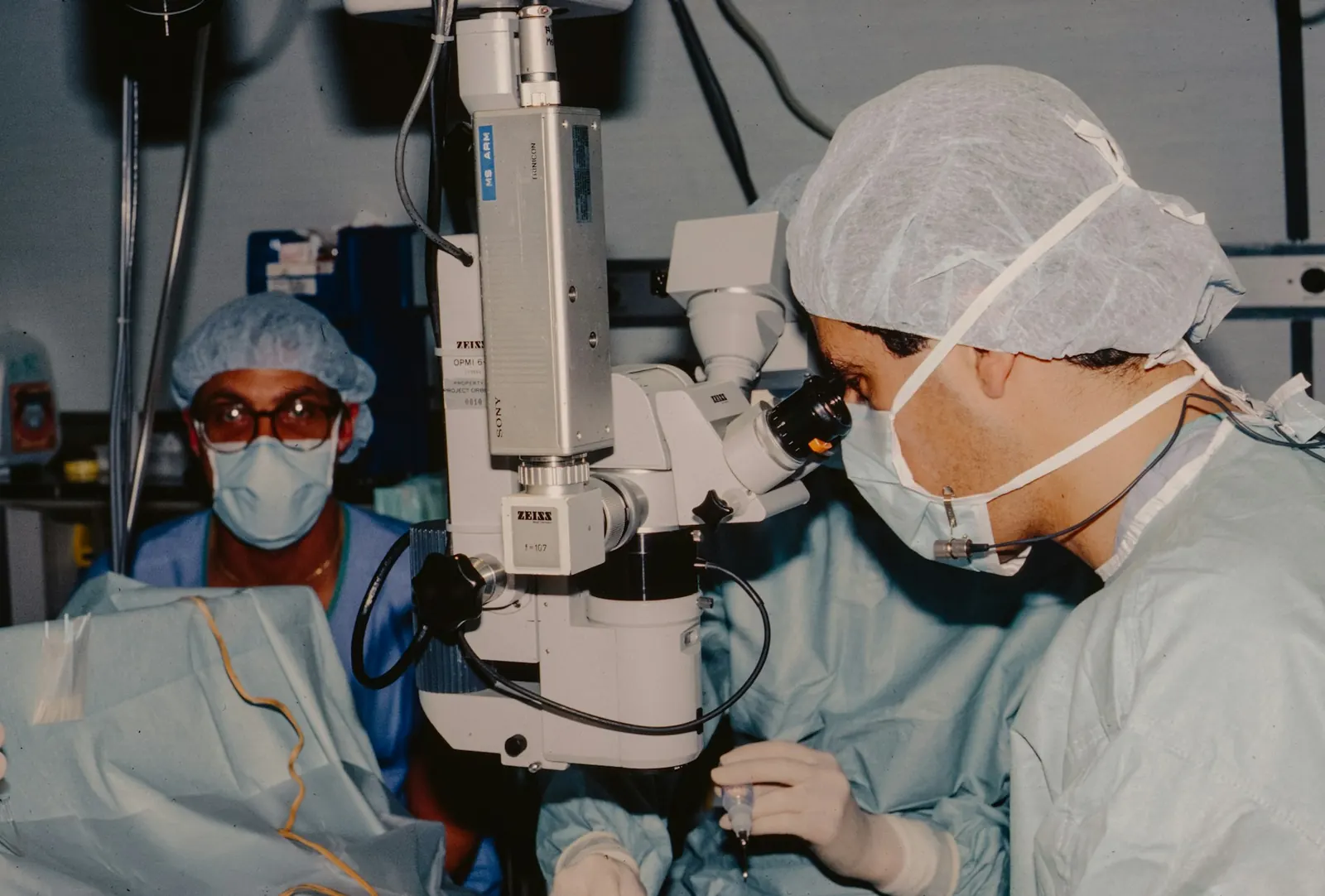
In a microscopic discectomy, the surgeon makes a small cut in the back, usually a few centimetres long. An operating microscope gives a bright, magnified view, so the nerve can be seen clearly and protected. Only the bulging piece of disc is removed. The rest of the disc is left in place.
This is a well-established operation for slipped discs in the lower back. It does not involve putting screws or rods in the spine. Most slipped discs improve without surgery, so this operation is one option among several.
Who may need it
Surgery is one option, not the only one. It is decided after an examination and a careful look at your scans, and non-surgical treatment is discussed first where it is suitable.
How it is done
- 1
You are given general anaesthesia, so you are fully asleep and feel no pain.
- 2
You lie on your stomach on a padded frame. The surgeon uses an X-ray to mark the correct level of the spine.
- 3
A small cut is made in the middle of the lower back, and the back muscles are gently moved aside.
- 4
A small window of bone and ligament is removed to reach the nerve. The operating microscope is used from this point.
- 5
The nerve is gently moved aside and protected, and the bulging piece of disc is removed.
- 6
The surgeon checks that the nerve is free, and the cut is closed with stitches.
Possible risks
Every operation carries some risk. Your surgeon will explain which of these apply to you.
Preparing for surgery
Recovery
Most patients start walking on the same day or the next day. The usual hospital stay is about 1 to 3 days. Leg pain often improves quickly. Numbness and tingling can take longer to settle, sometimes a few months.
Read moreShow less
Walk a little more each day. For the first few weeks, avoid lifting heavy things, long car or bus trips without breaks, and sudden bending or twisting. Many people with desk jobs go back to work in about 2 to 4 weeks. Heavy manual work usually needs a longer break.
Your surgeon will see you to check the wound and remove stitches if needed. Physiotherapy exercises, a healthy weight and safe lifting habits help protect your back over the long term.
Questions patients ask
Is microscopic discectomy a big operation?
It is a common and well-established spine operation done through a small cut. It does not involve screws or rods. Most patients walk soon after surgery and go home within a few days.
How is it different from endoscopic spine surgery?
Both remove the bulging part of the disc. Microscopic discectomy uses a microscope and a slightly larger cut, while endoscopic surgery uses a thin camera through a smaller cut. The choice depends on the type and position of the disc, your scans and your surgeon's advice.
Can I avoid surgery for my slip disc?
Often, yes. Many slipped discs improve with rest, medicines, physiotherapy and time. Some patients are also offered an injection near the nerve. Surgery is usually advised when pain does not settle, when there is increasing weakness, or when bladder or bowel control is affected.
Will I be paralysed after spine surgery?
This is a common fear. In the lower back, the nerves are below the end of the spinal cord, and serious nerve injury from this operation is uncommon. Like any surgery it has risks, which your surgeon will explain to you before you decide.
When can I go back to work?
Many people with office or desk work return in about 2 to 4 weeks. People whose work involves lifting or heavy labour usually need longer. Your surgeon will guide you based on your recovery.
Disclaimer: This information is for general awareness and is not a substitute for a medical consultation. Read moreSource: Content on this website was prepared with the help of AI tools (AI-assisted) and is medically reviewed by Dr. Kshitiz Nigam, MBBS, MS, MCh (Neurosurgery), Reg. No. MP-33282.